

kubectl debug node. Lumovi starts a short-lived privileged pod on the node, opens a shell through it, and deletes the pod when the shell ends. You don’t need SSH access to the node: your RBAC, and the Pod Security of the namespace the pod runs in, decide whether you can.
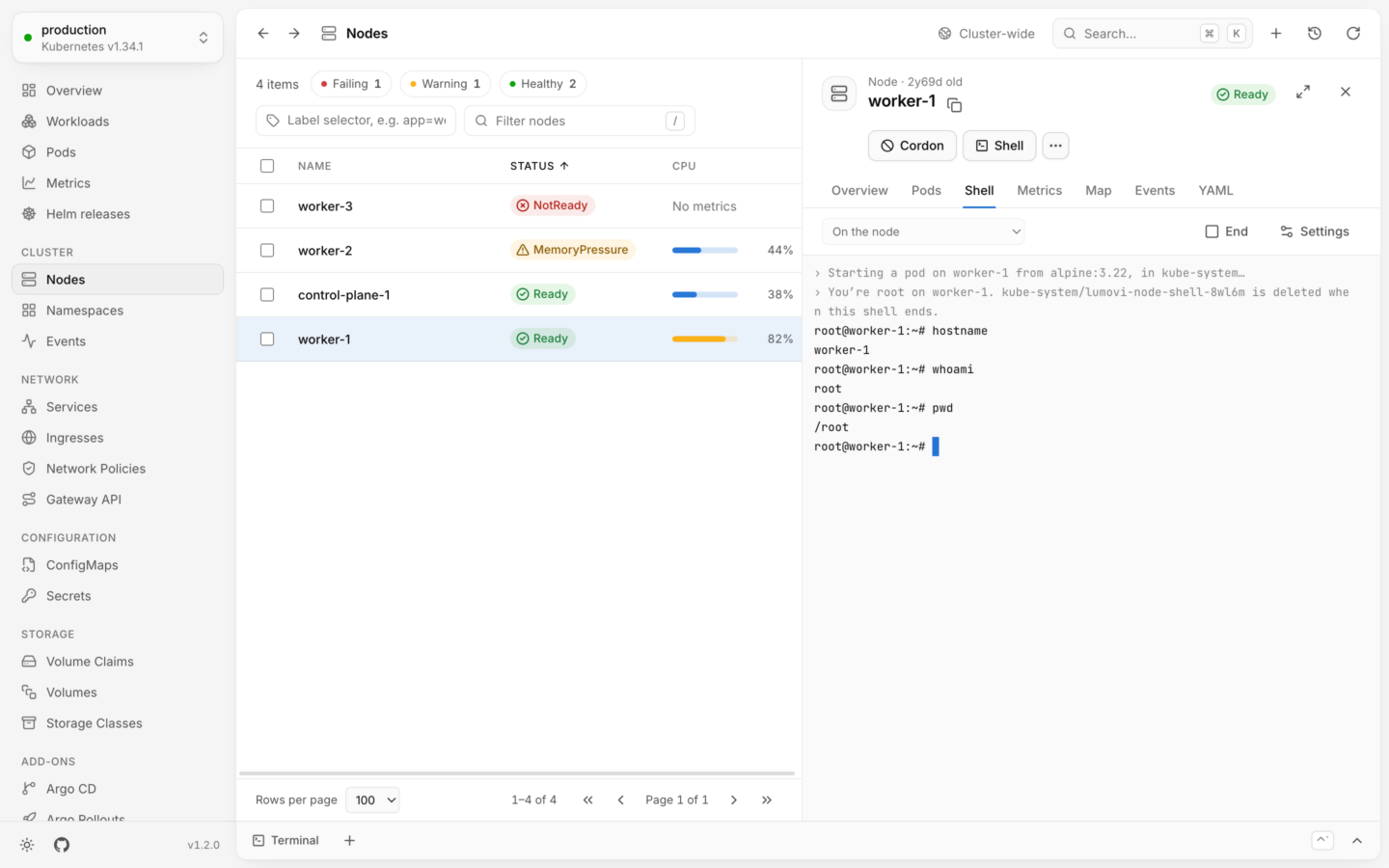
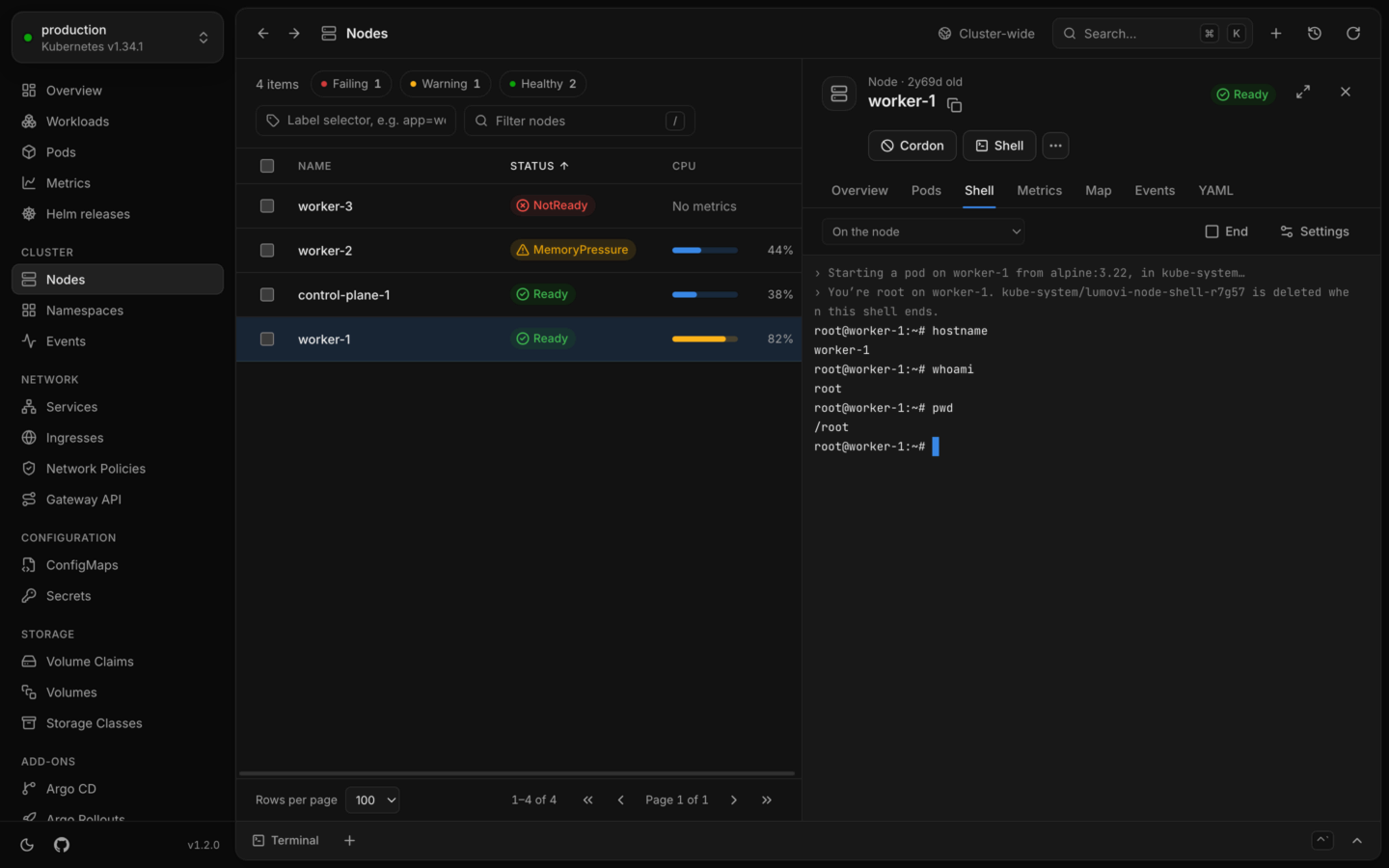
A shell on a node itself, as root, through a pod Lumovi starts there and deletes when the shell ends.
Open a shell on a node
1
Open the node
Find it in Nodes, and open it.
2
Choose Shell
Choose Shell at the top of the panel, or open the Shell tab. Nothing starts yet: the tab says what will happen first.
3
Pick where the shell runs
On the node, the default, or In the pod, with the node’s files, from the menu at the top of the tab. See Where the shell runs.
4
Start shell
Choose Start shell. The terminal shows each step as it happens, and the shell opens once the node has started the pod.
It also warns you, though you can still start the shell:
Then the terminal says what’s happening, in dim lines before the shell’s own:
Where the shell runs
What Lumovi runs in the pod. On the node, it first checks that the image has
nsenter, so a missing one says so instead of looking like a node without a shell:
The pod
Lumovi creates a pod namedlumovi-node-shell- and five random characters, in the node shells’ namespace (kube-system unless you choose another). It’s:
- Privileged, sharing the node’s process, network and IPC namespaces, with the node’s root filesystem mounted at
/host. - Placed on the node by name rather than scheduled, and it tolerates every taint, so cordoned and tainted nodes get it too.
- Without a service account token: it has no access to the API of its own.
- Labeled
app.kubernetes.io/managed-by: lumoviandapp.kubernetes.io/component: node-shell, with the node’s name in itslumovi.dev/nodeannotation.
The pod Lumovi creates
The pod Lumovi creates
For
worker-1, with the default settings. The API server adds the five random characters to its name.How long it lives
As long as the shell. Lumovi deletes the pod at once when the shell ends, which it does when:- You choose End, or the shell exits.
- The connection to the pod closes.
- You open another of the panel’s tabs, open something else, or close the panel.
- You quit the desktop app, which waits a few seconds for the pod to go, or leave the page in a browser.
Lumovi couldn’t delete its pod, kube-system/lumovi-node-shell-x7k2p: why. It stops by itself within 12 hours.That’s the pod’s deadline. Its container only sleeps for 12 hours, and Kubernetes stops the pod then too (
activeDeadlineSeconds), even when Lumovi isn’t there to delete it, because the desktop app quit before it could, say. A stopped pod stays in the namespace until it’s deleted. To find the node shells’ pods:
Settings for each cluster
Choose Settings at the top of the Shell tab. The Node shells dialog says where the pod is created, and what it runs:
Save keeps them for this cluster, once the namespace is a namespace’s name and the image has no spaces. The next shell uses them; one that’s open keeps going. Once you’ve set your own, Use the defaults: kube-system, alpine:3.22 goes back to the defaults.
The desktop app keeps these settings with its others, by kubeconfig context. In a browser, Lumovi in your cluster keeps them in that browser, for each cluster: another browser, or another person, has its own.
The equivalent command
The dialog shows thekubectl debug node command that does much the same, for where the shell runs:
-- sh -l. Unlike Lumovi, kubectl debug node leaves its pod behind when the shell ends: delete it yourself.
In your cluster: the administrator sets the namespace and image everyone starts with, with the chart’s
nodeShell.namespace and nodeShell.image (LUMOVI_NODE_SHELL_NAMESPACE and LUMOVI_NODE_SHELL_IMAGE), and can turn node shells off for everyone with nodeShell.enabled: false (LUMOVI_NODE_SHELL=off). In a fleet, these are every cluster’s. Each person can still choose another namespace and image for themselves, kept in their browser, and Use the defaults goes back to the server’s. The pod is created, and the shell opened, as the person signed in, with their RBAC: not as Lumovi’s service account. When Lumovi itself stops, after an upgrade say, it waits up to 10 seconds for open node shells’ pods to be deleted. See Helm values and Security.What it needs
Permissions
All in the node shells’ namespace:
Lumovi asks the cluster before you start. Without
create or get on pods, or create on pods/exec, the tab says No node shell access: Your account can’t create pods in kube-system, read them, or open shells in them. A node shell needs all three: ask for them, or choose another namespace in its settings. See Permissions.
A Role for node shells
A Role for node shells
Bind it to the people who may be root on the cluster’s nodes, in the namespace node shells run in:Creating pods in a namespace that allows privileged pods is enough to be root on any node. Give it only to those who should be.
Pod Security
The namespace’s Pod Security level must beprivileged: a namespace whose pod-security.kubernetes.io/enforce label is baseline or restricted refuses the pod. kube-system usually allows privileged pods. Policy engines, like Kyverno or Gatekeeper, can refuse it too.
The image
The default,alpine:3.22, comes from Docker Hub. It has sh and nsenter, which shells on the node need. A shell in the pod needs only sh. Where nodes can’t pull from Docker Hub, or shouldn’t, copy the image to your own registry and set it in Settings.
When it doesn’t start
Whenever a shell can’t start, Lumovi deletes its pod, and says why in words that say what to do. Most messages come with Settings and Try again: after you save the settings, the tab goes back to the start.The namespace doesn't allow privileged pods
The namespace doesn't allow privileged pods
namespace doesn’t allow privileged pods: its Pod Security level is stricter than privileged. Choose a namespace that allows them in the node shell’s settings.Choose Settings, and a namespace whose Pod Security level is
privileged, like kube-system. See Pod Security.Lumovi couldn't create the pod
Lumovi couldn't create the pod
Lumovi couldn’t create the node shell’s pod: what Kubernetes saidKubernetes refused it for another reason, in its own words: your account can’t create pods there, a quota is full, or a policy refused it. Fix what it names, or choose another namespace in Settings.
The node can't pull or start the image
The node can't pull or start the image
node couldn’t start image (ErrImagePull): why. Choose an image it can pull in the node shell’s settings.The reason in brackets is the container’s:
ErrImagePull, ImagePullBackOff, InvalidImageName, ErrImageNeverPull, CreateContainerConfigError or CreateContainerError. Check the image’s name, or choose a copy in a registry the node can reach, in Settings.The node refused the pod
The node refused the pod
node refused the node shell’s pod (OutOfpods): whyThe node’s kubelet turned the pod down, and the reason and message in it are the kubelet’s.
OutOfpods, for one, means the node already runs as many pods as it can.The node never starts the pod
The node never starts the pod
node didn’t start the node shell’s pod in 120 seconds: its kubelet may not be running, or image may take long to pull.Lumovi waits six times
LUMOVI_REQUEST_TIMEOUT_MS, two minutes unless it’s set. Check the node’s status and its conditions in Nodes: a node that isn’t ready may never start the pod. A large image may only need longer: Try again once the node has pulled it.The node has no shell of its own
The node has no shell of its own
node has no shell of its own. Talos and Bottlerocket nodes, say, have none. The pod’s shell has the node’s files under /host.Choose Shell in the pod for a shell in the pod instead, with the node’s files under
/host. Lumovi says this only when a shell on the node ends that way before you’ve typed anything: afterwards, the code is the last command’s.The image has no nsenter
The image has no nsenter
image has no nsenter. A shell on the node itself runs the image’s nsenter: alpine has it. (A shell in the pod doesn’t need it.)Its pod was deleted. Choose another image in Settings, like
alpine, then Try again, or choose In the pod, which doesn’t need nsenter.The image has no shell
The image has no shell
image has no shell. A node shell’s image needs sh, and nsenter for shells on the node itself: alpine has both.Distroless images, say, have none. Choose another image in Settings, then Try again.
When it ends
Under it, Its pod was deleted., or why it couldn’t be. Start again starts a new shell, in a new pod.
When a node shell isn’t offered
Windows nodes
Windows nodes can’t have a node shell: their containers can’t share a node’s namespaces the way a node shell needs. Their Shell tab says Node shells need a Linux node.Read-only clusters
A read-only cluster turns shells off, on nodes too. The Shell tab says Shells are off, as the cluster is read-only in Lumovi and a node shell can change the node. It isn’t only the tab: the part of Lumovi that talks to the cluster refuses to start one. See Read-only mode.Security
Shells and debugging
A shell in a container, or a debug container with tools.
Nodes
Every node’s health and load, and ways to take one out of service.