

On Windows and Linux, use Ctrl where these pages say ⌘.
These kinds have no health of their own, so their lists sort by name. To see whether a service has pods behind it, open it.
Services
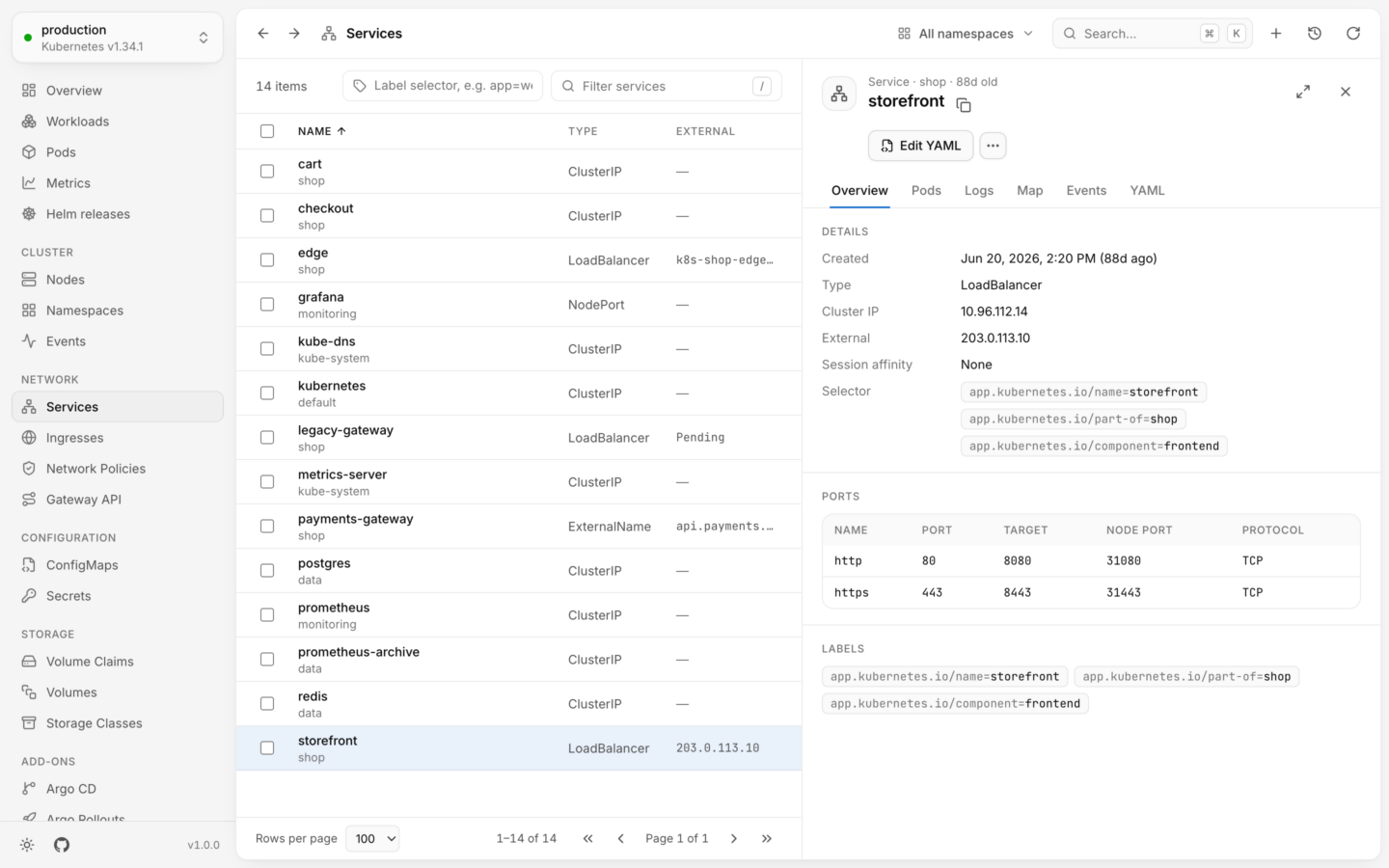

A service, its selector and its ports.
- Details: its type, cluster IP, external address, session affinity and selector.
- Ports: each port’s name, port, target, node port and protocol.
- Pods: the pods its selector matches, failing ones first. If this list is empty, the service has nowhere to send traffic.
- Logs: the logs of every pod behind it, merged in the order they were written. Handy for following a request across replicas. See Logs.
- Map: what routes traffic to it, like ingresses and HTTPRoutes, and the pods it sends it to. See Map.
- Events and YAML.
ExternalName service, has no Pods or Logs tab: it has no pods of its own.
Reach a service from your computer
Desktop app Forward a port… on a service listens on a port on your computer and passes connections to the service’s first ready pod, likekubectl port-forward service/web 8080:80. It works for services with a selector. See Port forwarding.
Ingresses
Open an ingress for its class, address and TLS hosts, and its Rules: each host and path, and where it sends that traffic. That’s a service and its port, likeweb:80, or for a backend of another kind, its kind and name. Traffic that no rule takes goes to the ingress’s default backend, listed last with host * and path Anything else. An ingress with no rules at all shows * in the list’s Hosts column. Its Map shows the services it routes to, and what’s behind them.
Using the Gateway API or Istio instead? Their kinds, like HTTPRoute, Gateway and VirtualService, have views with the columns and links that matter for them, and Gateway API has its own page under Network. See Add-ons and Built-in views.
Network policies
Open a policy for the pods it applies to (its Pod selector, or All pods in namespace), its policy types, and how many ingress and egress rules it has. The rules themselves are in YAML, and its Map shows the pods it applies to.Port forwarding
Reach a pod or service on localhost.
Config and storage
ConfigMaps, Secrets, volumes and storage classes.